

Organization
Users & Roles
Users can be created within the platform to give people access to vehicles, groups, and applications within the system. Users are always created with an email address and you have the option once you create them to send an email with instructions for how they can log in.
Roles is a new feature that simplifies user management by allowing administrators to create templates for user roles, making it easy to assign consistent access and permissions. This helps ease the management of multiple users across the platform.
Key Features
- Customizable Templates Tailor roles to fit specific organizational needs.
- Efficient User Management Save time by quickly assign users to roles, reducing manual efforts
- Role Consistency Ensure uniform access and permissions across users.
- Integration with the System You can use roles within the platform for triggers actions and report scheduling.
Setup and Configuration
To access the roles feature, navigate to the Organization section under "Users & Roles", create a new User.
Enter a first name and last name and under the "Access" option select "Role" (Note that the email address is automatically generated for roles based on the first and last name.
Configure the scopes and gateway functionalities or features for that role.
Finally, you can go back to the INFO section and select the users that will have this role applied.
Now any change you make to that role for the scopes or features will be reflected on all the users for that role.
Additional Notes
- Users can belong to multiple roles, with the most permissive scope prevailing, in other words if a user belongs to two roles and one of them has the permission to create geofences but the other one doesn't the user will be allowed to create geofences.
- A user can be assigned to a maximum of ten roles.
Devices
Segment Setup
Segment configuration is required to record an entity’s cycles. Each segment represents a single state—either working or resting. The working segment reflects active time within the cycle, while the resting segment represents downtime.
A work cycle corresponds to the entity’s workday and typically consists of two segments: one working segment and one resting segment.
The Hours of Service (segment setup) has the following parameters:
- Maximum Working Time: The maximum number of hours an entity can work within a cycle. If this limit is exceeded, the entity is considered overworked and the cycle becomes invalid. Example: If the maximum working time is 8 hours, any work beyond 8 hours invalidates the cycle.
- Minimum Rest Time: The minimum continuous rest required to create a rest segment. Once this threshold is met, the system ends the work segment and begins a rest segment starting from the time rest began. Example: If set to 4 hours, a vehicle that remains off or motionless (based on the configured signal) for at least 4 hours will trigger a rest segment.
- Maximum Continuous Working: Time The maximum time an entity can work without interruption during a cycle. Exceeding this limit marks the entity as overworked and invalidates the cycle. Example: If set to 2 hours, working continuously beyond 2 hours without a break will invalidate the cycle.
- Minimum Break Time: The minimum duration of rest required to qualify as a break. Example: If set to 0.25 hours, the entity must rest for at least 15 minutes for the period to be considered a valid break.
- Enable Work Cycle Analysis Using Driving Time Only: Excludes break periods from work cycle calculations. Violations (overwork alerts) are based solely on active driving time, while breaks are still recorded for reference and analysis.
- Partition Signal: Defines the signal used to determine when the entity is working or resting. Options include:
- moving: The vehicle is considered moving when its speed exceeds 3 mph and a valid GPS position is available.
- ignition: Indicates whether the vehicle is turned on or off.
- speed_distance: Determines whether a vehicle is working by evaluating speed and distance across three cases. See Speed distance signal for configuration details.
Speed distance signal
Use the speed_distance partition signal to identify working activity when a vehicle meets any of three conditions. The system evaluates the conditions in order: it checks Case 2 only when Case 1 is not met, and checks Case 3 only when neither Case 1 nor Case 2 is met.
-
Select
speed_distanceas the partition signal.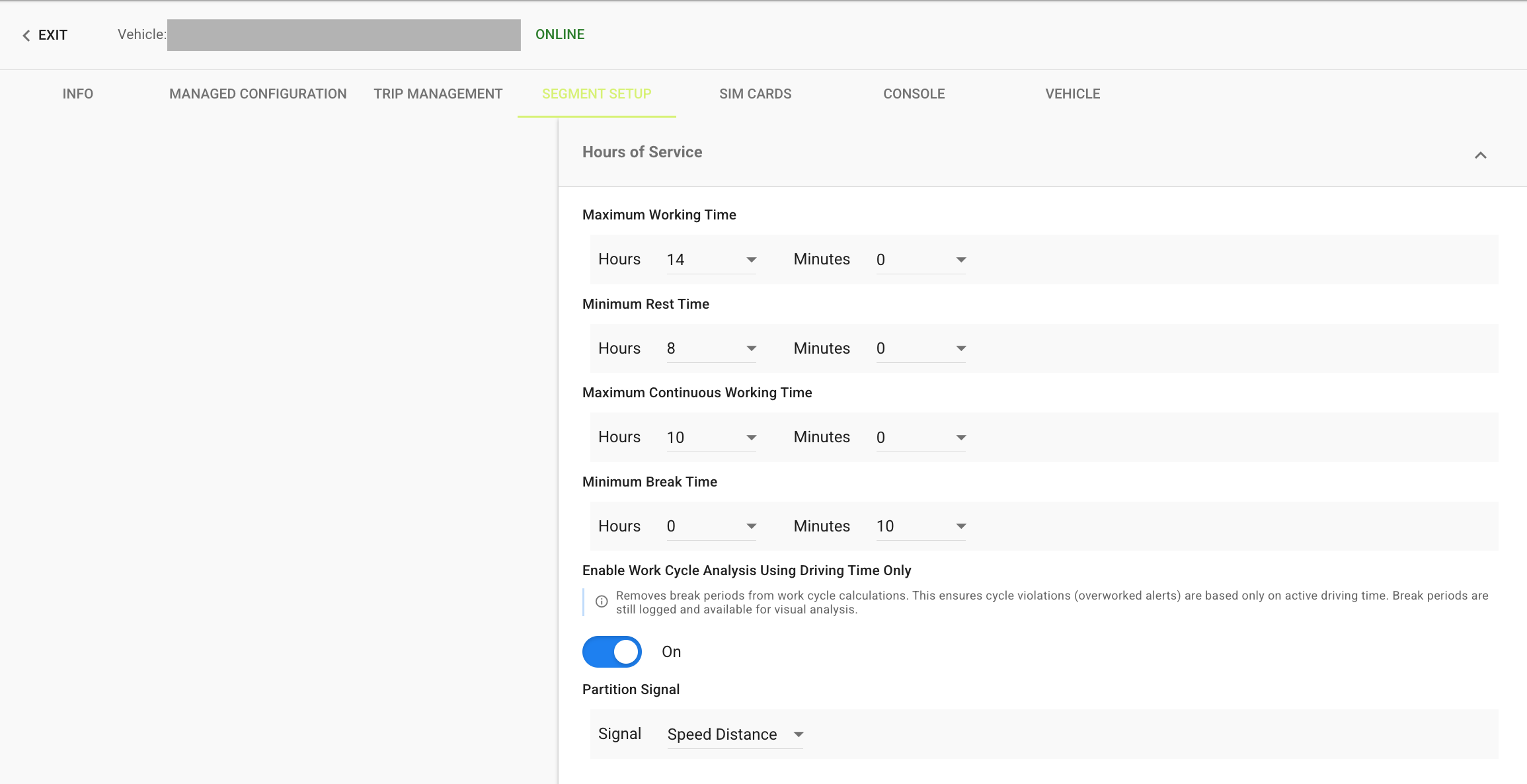
-
The system determines that the vehicle is working when one of the following cases is satisfied:
Case 1. Minimum speed: The vehicle is considered working when the reported speed is greater than or equal to minimum_speed. When this condition is met, the system immediately classifies the vehicle as working and does not evaluate the remaining cases. This case detects clear vehicle movement based on the reported speed, without requiring distance calculation.
Default value: 10.46 km/h (6.5 mph)
Configurable range: 5–65 km/h
Case 2. Minimum distance (Slow but consistent Movement): When the reported speed is below minimum_speed, the system calculates the distance traveled and the average speed between the previous and current events. The vehicle is considered working when all the following conditions are met:
- The reported speed is at least 0.5 mph.
- The distance traveled exceeds minimum_distance.
- The calculated average speed between both events is greater than 2 km/h.
Default value: 5 m (16.4 ft)
Configurable range: 1–500 m
Case 3. Movement distance: When neither the minimum speed nor minimum distance conditions are satisfied, the system evaluates the displacement between the previous and current events. The vehicle is considered working when all the following conditions are met:
- The distance traveled exceeds movement_distance.
- The elapsed time between both events allows a valid speed calculation.
- The calculated average speed between both events is between 1 km/h and 200 km/h.
This case detects significant vehicle displacement when the reported speed is unavailable, inaccurate, or too low to trigger the previous conditions, while avoiding false positives caused by invalid GPS jumps.
Default value: 50 m (164 ft)
Configurable range: 10 – 1,500 meters
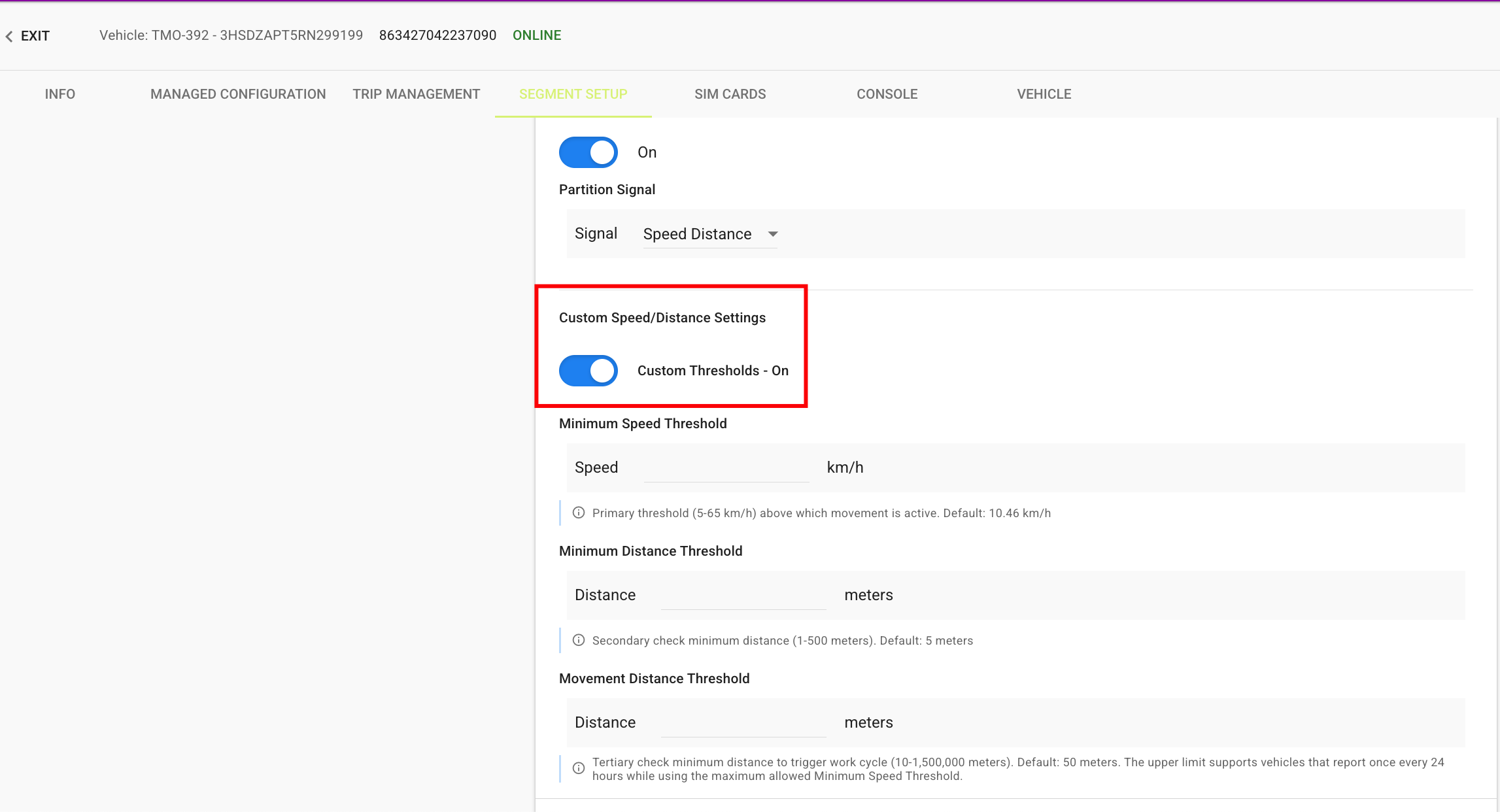
Optional: Configure speed and distance values
If you select speed_distance without enabling custom configuration, the system applies the default values for each case.
Configure this signal to prevent vehicle movements within a yard—such as relocation, loading and unloading, maintenance, or fueling—from creating false work segments.
Enable custom configuration to enter values for the available speed and distance settings.
Configuration Examples
- Good configuration (yard operation)
A fleet where trucks regularly relocate 15–30 m (49–98 ft) within a yard for loading and fueling, and these movements should NOT count as work. Devices report approximately every 60 seconds.
Minimum Speed Threshold: 16.1 km/h (10 mph)
Minimum Distance Threshold: 40 m (131 ft)
Movement Distance Threshold: 100 m (328 ft)
Scenario: A truck moves 25 m (82 ft) in 60 seconds within the yard at 3.2 km/h (2 mph).
Rule 1: 3.2 km/h (2 mph) < 16.1 km/h (10 mph) → does not trigger.
Rule 2: distance 25 m (82 ft) < 40 m (131 ft) threshold → does not trigger.
Rule 3: distance 25 m (82 ft) < 100 m (328 ft) threshold → does not trigger.
Result: Resting. The yard relocation is correctly ignored.
- Bad configuration (same yard, same device)
The administrator keeps the defaults or lowers them.
Minimum Speed Threshold: 10.46 km/h (6.5 mph)
Minimum Distance Threshold: 5 m (16.4 ft)
Movement Distance Threshold: 20 m (66 ft)
Same scenario: The same truck moves 25 m (82 ft) in 60 seconds at 3.2 km/h (2 mph).
Rule 1: 3.2 km/h (2 mph) < 10.46 km/h (6.5 mph) → does not trigger.
Rule 2: speed ≥ 0.8 km/h (0.5 mph) ✓, distance 25 m > 5 m ✓, average speed = (0.025 km / 0.0167 h) = 1.5 km/h (0.93 mph) < 2 km/h (1.24 mph) → does not trigger (average too low).
Rule 3: distance 25 m (82 ft) > 20 m (66 ft) ✓, time valid ✓, average speed 1.5 km/h (0.93 mph) is between 1 and 200 km/h ✓ → triggers.
Result: Working. A simple dock relocation breaks the driver's accumulated rest and generates a false work segment.
When configuring thresholds, consider how far your vehicles typically move between consecutive device reports AND how often those reports arrive. A truck that moves 30 m (98 ft) in 60 seconds produces a very different average speed than one that moves 30 m (98 ft) in 10 seconds. Both the distance thresholds and the reporting interval determine which rules will trigger.
Updated 6 days ago